CutBench: restriction mapping and virtual digests

CutBench finds recognition sites for more than 40 common restriction enzymes, highlights unique cutters for cloning, and simulates single or multi-enzyme digests on a virtual gel.

Open CutBenchAll tools

Free, no sign-up, and installable on your phone. Runs in your browser at digest.gataca.com.
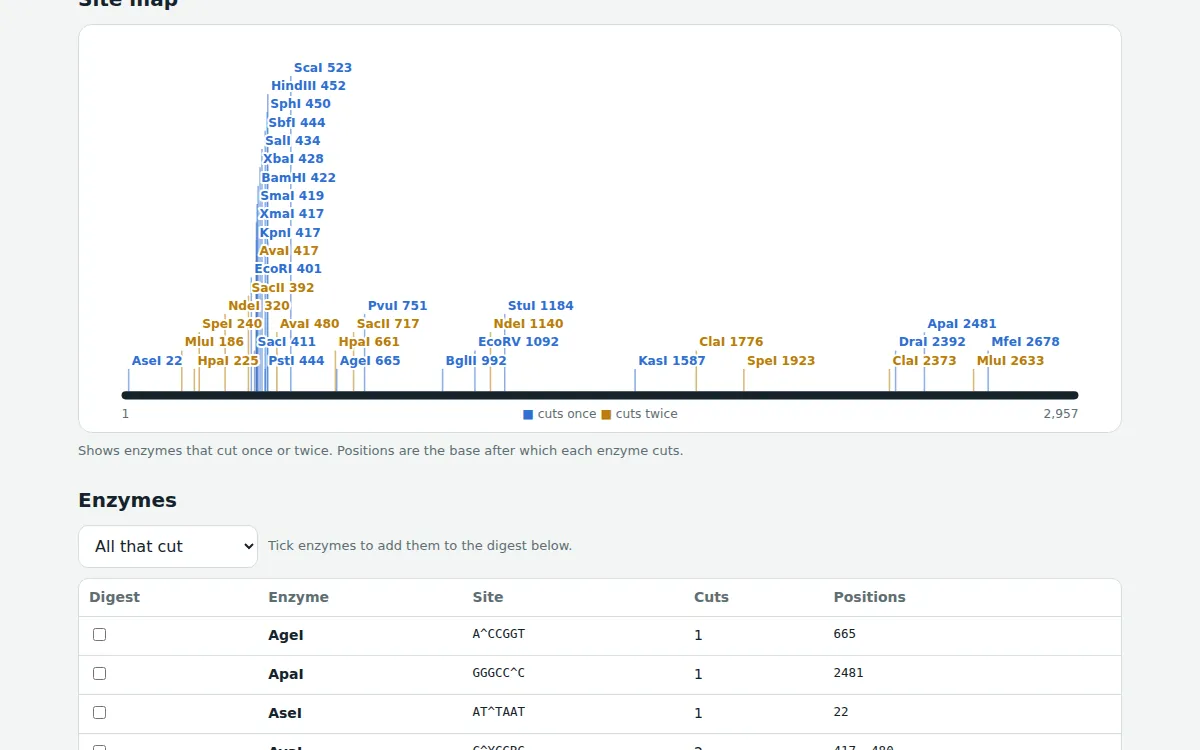
CutBench showing results for the built-in example
CutBench with its built-in example loaded.

What you can do with CutBench

  • Choose enzymes for cloning from the unique cutters in a plasmid
  • Plan a diagnostic digest to verify a construct
  • Predict fragment sizes before running a gel
  • Check whether an insert contains sites you plan to use

How to use it

  1. Paste your sequence and tick Circular for plasmids.
  2. Review the site map and the list of single, double, and non-cutting enzymes.
  3. Tick enzymes to add them to the digest.
  4. Read the fragment sizes and compare the virtual gel to your real one.

Features

  • More than 40 common enzymes, including degenerate sites like HincII
  • Linear and circular (plasmid) topology
  • Site map of single and double cutters
  • Fragment sizes for single and combined digests
  • Virtual 1% agarose gel with a 1 kb ladder
  • Save results as reports, spreadsheets, or sequence files
  • Install it on your phone or computer; works offline

Frequently asked questions

Can I add my own enzymes?

Not yet. The built-in list covers the most widely used commercial enzymes. Contact us if you need a specific enzyme added.

Does CutBench account for methylation?

No. Dam and Dcm methylation can block some sites in DNA grown in E. coli. Check your enzyme supplier's methylation sensitivity notes.

How do circular digests work?

For circular DNA, CutBench finds sites that span the origin and joins the last and first fragments, as happens in a real plasmid digest.

More free tools

Need CutBench to do more?

We build custom versions and full pipelines for research teams.
Talk to us